Published: Thursday, August 27, 2026
Last updated: Thursday, August 27, 2026
Toward Clinically Grounded LLMs: Fine-Tuning on Real Therapy Dynamics
Written by: Akele Reed, Principal AI Engineer and Anne Clarke, Research Associate and AI Engineer
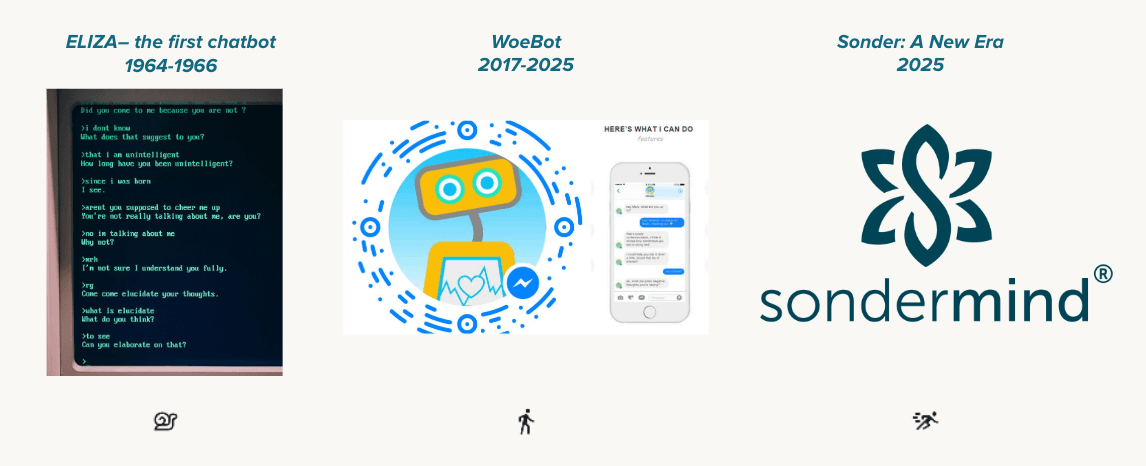
ELIZA crawled so that Woebot could walk
In 1964, Joseph Weizenbaum wrote a program that reflected your sentences back at you as questions. ELIZA had no model of anything, and people confided in it anyway. That was the crawl.
Woebot walked. Launched in 2017, it paired scripted Cognitive Behavioral Therapy with real intent recognition, earned an FDA breakthrough designation, and had millions of users, using good old-fashioned AI. Now, we get to run.
Frontier models can hold a genuinely fluid conversation about someone's life; they can mimic humans in an unprecedented way, but they have limitations, especially in the context of mental health. We’re closing that gap by fine-tuning on the dynamics of real care, leveraging data from SonderMind’s provider network.
The failures nobody is counting
Today, in the United States, mental health support is one of the top use cases for AI. Most of that usage is with frontier models like ChatGPT and Claude, which are not built for mental health specifically. This has resulted in some extremely tragic events, known as macrofailures. Those failures are real and incredibly impactful, and they are the statistical tail. Support runs along a spectrum, and responses cannot be cleanly classified into harmful or helpful.
Instead, we introduce four categories of responses:
1. Macro-failures
2. Micro-failures
3. Neutral
4. Helpful

However, nobody is measuring the micro-failures. These are the nuanced responses that cause short-term distress, discomfort, or other negative effects. They are often not recognizable by the average person, which makes them difficult to recognize, let alone count.
An AI assistant tells a user with severe anxiety that their symptoms sound like a personality disorder, and now the user is filtering everything through that lens, despite lacking an official diagnosis. A user could say "my ex is such a narcissist" and gets warm agreement, because pop-psychology framing reads as validation and validation reads as engagement. A model optimized for engagement picks the response that feels good over the one that actually helps, and no prompt engineering reliably fixes that.
Why fine-tune the clinically grounded AI companion, Sonder
Sonder, our clinically guided AI companion, entered beta in December 2025 on a heavily prompt- and agentically engineered frontier model wrapped in a guardrails framework we've since partially open-sourced. That architecture works, and we hit its ceiling: prompts and guardrails constrain what a model does at the edges, but they don't change what it reaches for by default.
Our thesis is that the art of therapy is more nuanced than agentic engineering with frontier models alone can capture. A therapist's instinct to sit in silence, to redirect instead of reassure, to notice that the stated problem isn't the problem aren’t rules you can hand a model. It's a disposition, and we wanted it baked into the weights of the model itself. That’s why people have best friends and therapists.
So we fine-tune with Low-Rank Adaptation (LoRA). Foundation models need shifting, not rebuilding: small adapters over frozen base weights move behavior cheaply and limit catastrophic forgetting. It also buys flexibility at serving time: one base model with adapters we can swap out as needed. We tuned the configuration to preserve base-model safety while learning therapeutic inclination.
Boiling transcripts down to therapeutic dynamics
The signal we want comes from SonderMind's provider network, filled with real clinicians helping real people get better, across millions of sessions. It is also the most sensitive data we hold, so HIPAA compliance and member privacy are paramount. We don't train on transcripts. Session data moves through an ordered pipeline of de-identification, cleaning, obfuscation, pseudonymization, and then a distillation step that reduces each session to its therapeutic dynamics: the structure of the exchange, the modality and technique in play, the shape of the clinical move. The specifics of a person's life are precisely what we throw away before training even begins. What’s left for the model is what good therapy actually looks like, and that’s exactly what’s missing from frontier LLMs.
Strip away too little, and you carry leakage risk into the weights; strip too much, and there's no signal left to learn. Finding the middle took custom evaluation, research review, and clinician input; then memorization checks confirmed the model absorbed no specifics.
Evaluation is the hard problem
Training the model was not the hardest part. Knowing whether it got better was. Our core paradigm is that a frontier model judges synthetic conversations between a simulated user and our model, with profiles held constant so comparisons mean something.
On top of that, we evaluate on four pillars: Clinical Quality, Safety, Bias & Fairness, and Privacy. These evaluations are rigorous and scientific, designed to prove our thesis one way or another and ultimately help Sonder users get the best possible support.
The results so far say the thesis holds. The fine-tuned model moves measurably toward human-clinician behavior on axes like guided discovery, pacing, and interpersonal effectiveness. It applies a more diverse set of techniques while staying more consistent within a conversation. And it pushes back. Not in a contrarian way, just not willing to simply agree for the sake of engagement.
Built on Ray so we could focus on the model
SonderMind is a specialized company for mental healthcare, not a model training company. We asked our platform team what building it from scratch would take: six-plus months before a single experiment. Instead, we built on Ray by Anyscale: Ray Data for preprocessing, Ray Train for distributed fine-tuning with FSDP and QLoRA, and Ray Serve for inference. Anyscale, Inc. absorbs the ops overhead, so a small team works on the hard problem, not the cluster.
Where this goes
We are discovering what role AI should play in mental health, and we believe that the answer comes from real humans helping real humans get better — handled with the privacy that data deserves, evaluated honestly enough to admit what we can't yet measure. We can train a model to be therapeutically inclined: to use the modalities real therapists use, to push back, to help people get better, in between sessions and for people who are not in human care.