Published: Wednesday, May 29, 2024
Last updated: Wednesday, October 22, 2025
Try These Couples Therapy Exercises At Home To Strengthen Your Relationship
Written by: SonderMind
Clinically reviewed by: Caroline Cauley, PhD, LP
The unspoken distance between two people can be the most painful part of a relationship. It's the moment you realize you are sitting on the couch together, watching a show, but you feel like you're miles apart. It's the slow, creeping sense that the person you've built a life with is a stranger, or perhaps, a well-known acquaintance. This quiet erosion of connection is more common than we admit. It doesn't arrive with a dramatic fight or a sudden betrayal, but rather, with the accumulation of tiny, unaddressed slights, misunderstandings, and miscommunications.
We see love stories on screen that move from conflict to resolution in a tidy two hours, leaving little room for the messy, repetitive work of real-life relationships. As a result, many couples feel deep shame when they struggle. Research indicates that the average couple waits roughly three years before seeking help for marital issues. This may sound abysmal at first, but it's a significant improvement compared to the 1994 findings from Dr. John Gottman, renowned relationship psychologist, researcher, and founder of the Gottman Institute. Thirty years ago, Gottman found that couples wait an average of six years before seeking help for marital problems. The tides are certainly turning, but for many, there can still be that feeling of shame or sadness.
These feelings are not just for couples in crisis. They are for anyone who has ever felt that quiet, painful distance. They are for those who want to move beyond just coexisting and begin to truly reconnect. The answer lies in at-home couples therapy exercises, simple yet profound activities that can serve as a bridge, providing a safe way to initiate some of those difficult conversations and build a stronger foundation.
Couples therapy exercises for communication
Extended eye contact
When was the last time you looked into your partner's eyes for a full minute? This simple exercise can feel awkward at first, but it can be a powerful way to build intimacy.
- Sit across from each other and set a timer for 30 seconds to a minute.
- Stare into each other's eyes without talking.
- As you get more comfortable, you can increase the time.
- Afterward, talk about what you felt and what you were thinking during the exercise.
The power of "I" statements
Arguments can get heated when it feels like one person is attacking the other. Instead of saying, "You never listen to me," which puts your partner on the defensive, you can use "I" statements to express your own feelings. This simple switch can change the entire tone of a conversation.
- You might say, "I feel frustrated when you come home late without a call," or "I feel lonely when we don't spend quality time together."
- Try out this formula: I feel (emotion) when (specific behavior).
Mirroring
Ever feel like your partner isn't really hearing you? Or that you're just waiting for your turn to talk? That's the purpose of this exercise. Mirroring is one of the foundational exercises for couples therapy. It's designed to make sure both people feel heard, safe and validated.
- One partner speaks for a set amount of time, about three to five minutes, without interruption. They can discuss their day, a specific issue, or a particular feeling.
- The other partner's only job is to listen intently. No nodding in agreement, no preparing a response, just listening.
- After the first person finishes, the listener mirrors what they heard. They might say, "What I heard you say was..." and then repeat the message in their own words. The speaker then confirms if the listener understood correctly by saying, "Did I get that right?"
- Then, you switch roles.
This practice forces you to slow down and truly process what your partner is saying, building empathy and understanding.
Active listening
Simply hearing what someone says is different from truly listening to them. Active listening exercises allow you to give your partner your full attention, not just with your ears, but with your whole body.
- When your partner is talking, put your phone away and give them your complete focus.
- When they're done, try to summarize what they said in your own words. This shows that you understood them and helps them feel heard.
- You can also use non-verbal cues, like making eye contact and nodding, to show that you're engaged.
Take this piece of advice from Dr. John Gottman, a renowned relationship researcher, marriage couselor, and founder of the Gottman Institute: "Remember what it means to be the listener. You don't react to what you're hearing. Just keep breathing, postpone your own agenda, and concentrate on your partner."
Using the emotional wheel
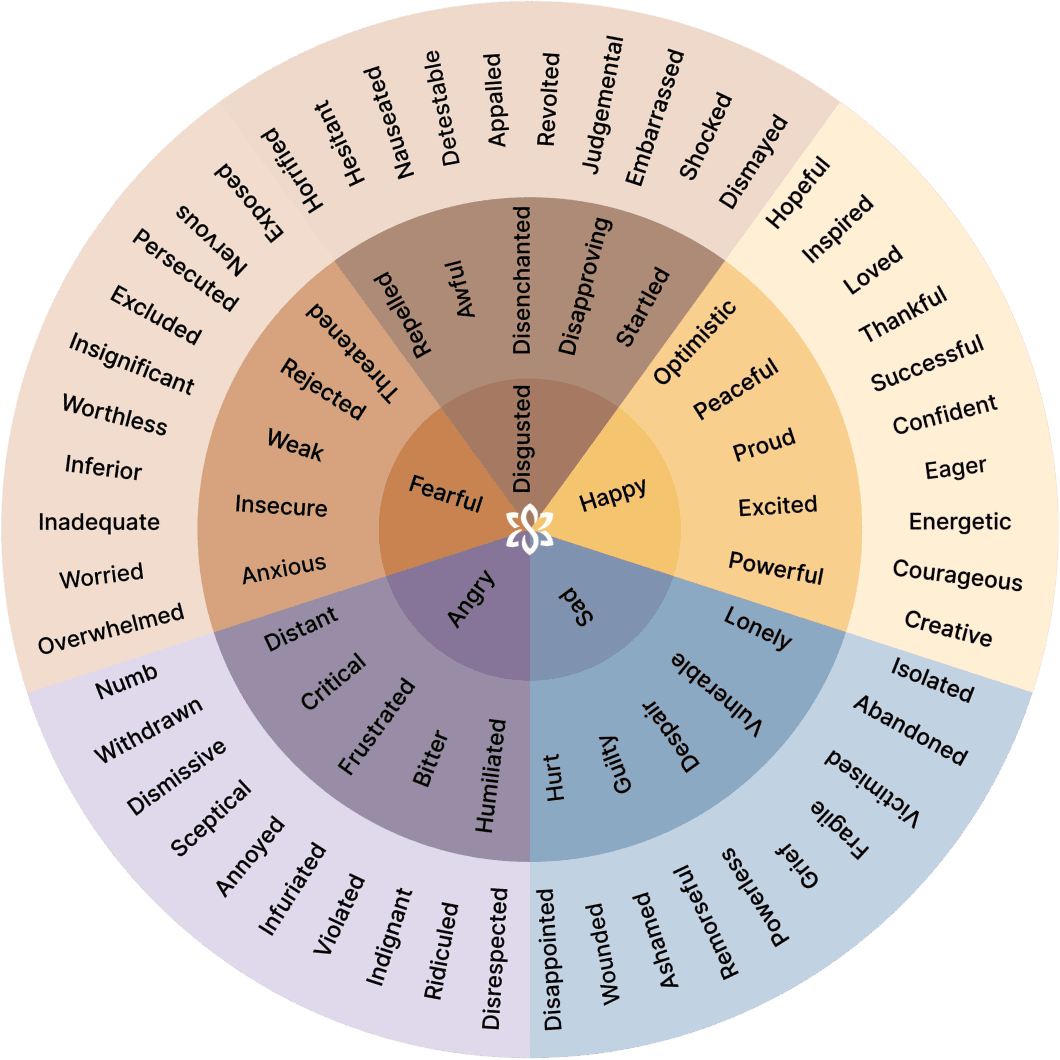
Sometimes it's hard to put a name to what you're feeling, and you might feel like your partner should be able to read your mind or body language to know how you’re feeling. Using language to communicate our feelings and why can clarify misunderstandings and foster closeness in relationships.
- When you're talking, you can use the emotional wheel to express the exact emotion you're feeling.
Instead of just saying "I'm upset," you can look at the wheel and find a more specific word, like "disappointed," "anxious," or "overwhelmed."
Couples therapy exercises for conflict management
Taking a time-out
In the middle of a heated argument, it's easy to say things you regret. The time-out technique gives you both a way to hit "pause" and cool down before things get worse. This gives time for the feelings of fight-or-flight to subside, which allows you to think more clearly.
- Agree beforehand that either of you can call a time-out when an argument is getting too intense.
- When a time-out is called, you both agree to take a break for a set amount of time, like 20 minutes or an hour. Don't go longer than 24 hours.
- During the time-out, try something to calm your mind, such as listening to music, taking a walk, or reading a book.
- When the time is up, come back together and talk about the conflict with calmer heads.
Conflict resolution practice
Arguments are a normal part of any relationship. What's most important is how you handle them. Conflict resolution practice gives you a chance to work through disagreements in a structured, healthy way.
- When a conflict arises, agree to follow a specific plan to resolve it. This might involve using active listening exercises, finding a compromise, or brainstorming a solution together.
- The goal isn't to win the argument—it's to understand the other person's perspective. It's to work as a team to solve the problem and move forward.
The role reversal exercise
Walking in your partner's shoes can be one of the most powerful ways to build empathy. This exercise, when conducted with clear rules and respect, can offer you a completely new perspective.
- Agree to some ground rules before you start. The goal isn't to mock or make fun of your partner. It's to understand them and see the situation from their perspective.
- Take turns acting as each other. Talk about a recent conflict or a tough day from your partner's point of view. Try to use their tone and explain what you think they were thinking and feeling.
Couples therapy exercises for building intimacy and connection
Regular relationship check-ins
Just like a car needs a tune-up to run smoothly, a relationship requires regular check-ins to prevent small issues from escalating into major problems.
- Set aside time to discuss your relationship. It could be once a week or once a month.
- During this time, you can discuss how you both feel about the relationship, any specific concerns you may have, or what you're excited about for the future.
Date night planning
When life gets busy, date nights are often the first thing to go. But having fun and new experiences together is a crucial part of maintaining intimacy and connection.
- Take turns planning a date night that you both will enjoy.
- The dates themselves don't have to be fancy. It could be a picnic in the park, a movie night at home, or trying a new restaurant.
- The planning is just as important as the date itself. It shows that you're both putting in effort and helps you build anticipation together.
The appreciation list
Create an appreciation list to help you both remember all the wonderful things that brought you together in the first place.
- Sit down together and make a list of things you appreciate about your partner. Take turns reading your lists to each other.
- These can be personality traits, such as their kindness or sense of humor, or specific actions, like always making coffee in the morning or remembering a special anniversary.
How to start the conversation
Bringing up couples therapy exercises can feel a bit awkward, but that's completely normal.
Here are a few ways to approach the topic:
- Embrace the silliness: You could say something like, "I came across this article with a few exercises, and I know it might sound a little cheesy, but I was thinking we could just try one out for a few minutes. If we end up laughing at it, even better!"
- Ask for a small commitment: Try saying, "Hey, could we set aside just 10 minutes tonight to try something new from this article I read? We can just do one to start and see how it goes."
The goal is to be open, honest, and not take it too seriously. The conversation itself is the first step toward working on your relationship together.
Beyond the exercises
When you're with your person, it's easy to get lost in the day-to-day. You make a home, you build a life, and you fall into a rhythm. But sometimes, that rhythm can become a routine that leaves out the most important part: the two of you.
Making time for your relationship is like tending to a garden. It requires consistent effort, patience, and a willingness to roll up your sleeves. These simple couples therapy exercises are an invitation to do just that—to put in the work, nurture your bond, and watch your relationship grow. They remind you that the person you chose to walk through life with is still there, and with a little intentional effort, you can find your way back to each other, one conversation at a time.
Note: This article provides general information and techniques for couples seeking to enhance their relationship. However, these exercises are not a substitute for professional therapy and/or psychiatry. If you or your partner is experiencing significant challenges such as intimate partner violence, infidelity, or severe mental health concerns, it is crucial to seek guidance from a qualified mental health professional.
4 Sources
- Retrieved from https://www.sondermind.com/resources/articles-and-content/desire-discrepancy/
- Retrieved from https://health.clevelandclinic.org/feelings-wheel
- Retrieved from https://info.gottman.com/blog/20-quotes-to-make-your-relationship-better#:~:text=Work%20on%20your%20communication%20and,John%20Gottman
- Retrieved from https://pubmed.ncbi.nlm.nih.gov/33411353/#:~:text=We%20found%20an%20average%20interval,individual%20therapy%20for%20relationship%20problems.